
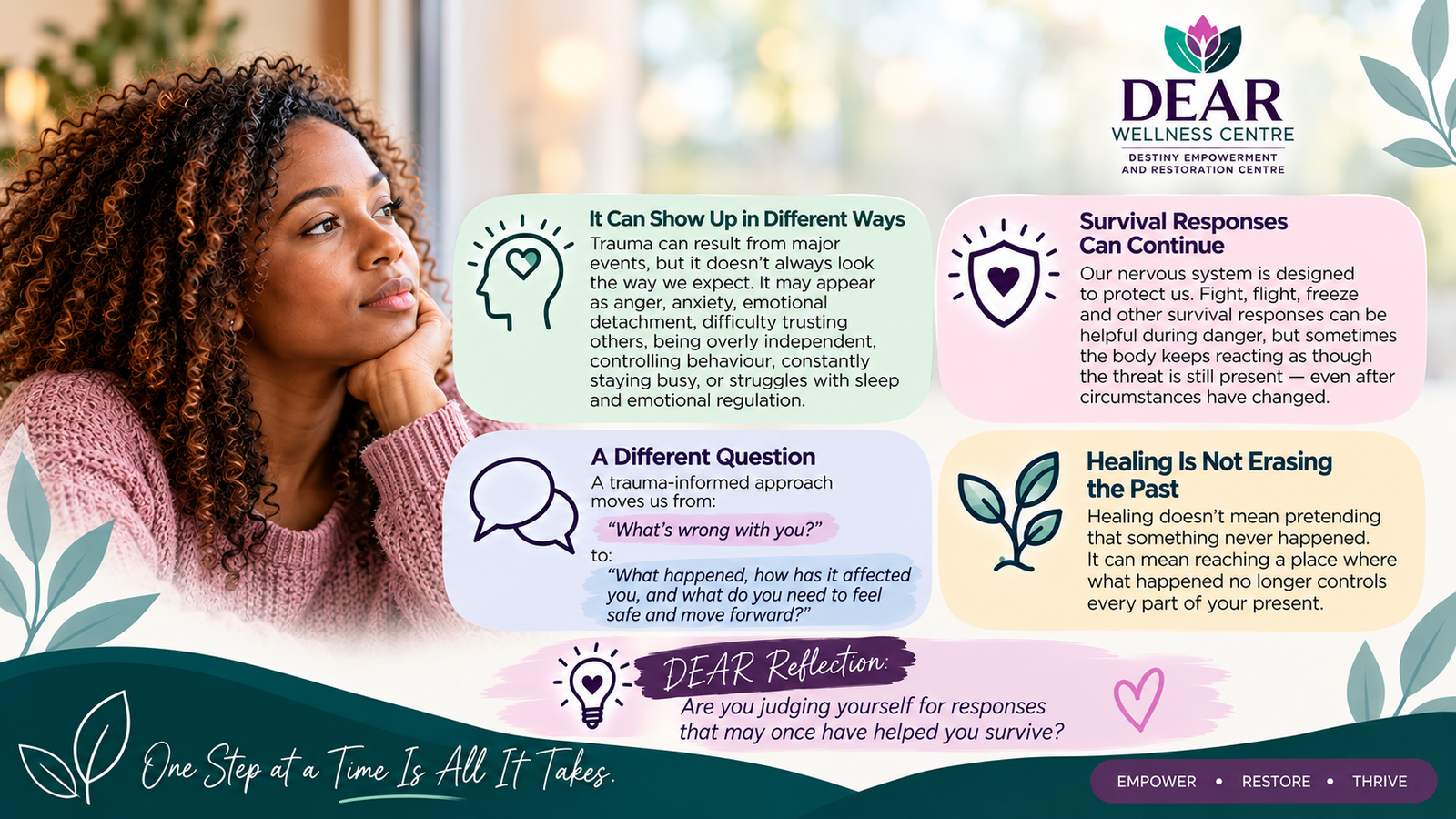
When people hear the word trauma, they often imagine one catastrophic event.
And certainly, deeply distressing events can have a significant psychological and emotional impact.
But trauma and its effects do not always look the way we expect.
Sometimes a person who has been deeply affected by difficult experiences does not appear visibly distressed at all.
They may appear highly independent, constantly busy, emotionally detached, angry, anxious or unusually controlling.
Others may struggle with trust, sleep, relationships or emotional regulation without immediately recognising the connection between their current reactions and earlier experiences.
Trauma Can Affect How We Experience the Present
The human nervous system is designed to help protect us from danger.
During threatening situations, the body may activate survival responses such as fight, flight or freeze.
These responses are useful when danger is present.
The difficulty can arise when the mind and body continue responding as though danger is still present even after circumstances have changed.
An ordinary disagreement may feel threatening.
A delayed message may trigger fear of rejection.
A raised voice may create an intense physical reaction.
A person may become extremely uncomfortable when they feel they have lost control.
From the outside, these reactions may appear excessive.
From inside the person’s experience, however, the nervous system may be trying to protect them.
Survival Responses Can Become Patterns
Some behaviours that appear unhealthy in adulthood may once have served an important protective function.
For example:
A person who rarely asks for help may have learned that relying on others was unsafe.
Someone who constantly monitors other people’s moods may have learned to anticipate conflict.
Someone who keeps constantly busy may find that slowing down allows painful memories or emotions to surface.
Understanding the origin of a behaviour does not mean that the behaviour must continue forever.
It provides context.
And context can help create a more compassionate starting point for change.
Trauma-Informed Support Asks a Different Question
When we see behaviour we do not understand, it is easy to ask:
“What’s wrong with you?”
A trauma-informed approach invites different questions:
“What happened?”
“How has it affected you?”
“What helps you feel safe?”
“What do you need in order to move forward?”
This shift does not remove personal responsibility.
It simply recognises that behaviour develops within a person’s experiences, relationships and environment.
Understanding those influences can help people develop healthier responses.
Healing Is Not Erasing the Past
Healing does not mean pretending something never happened.
It also does not require forgetting.
Healing may mean that the experience becomes one part of your story rather than controlling every part of your present.
It may look like:
- recognising triggers;
- learning emotional regulation;
- developing healthier boundaries;
- building safe relationships;
- challenging beliefs formed during painful experiences;
- asking for help;
- learning to trust gradually; and
- responding to the present rather than constantly reacting to the past.
Healing can take time.
Progress is rarely perfectly linear.
Your Responses May Have Had a Purpose
Sometimes people judge themselves harshly for the ways they cope.
They wonder why they cannot “just get over it.”
A more compassionate question may be:
“What was this response trying to protect me from?”
From there, you can begin asking whether the same response is still serving you today.
🌸 DEAR Reflection
Are you judging yourself for responses that may once have helped you survive?
Leave Your Comment