
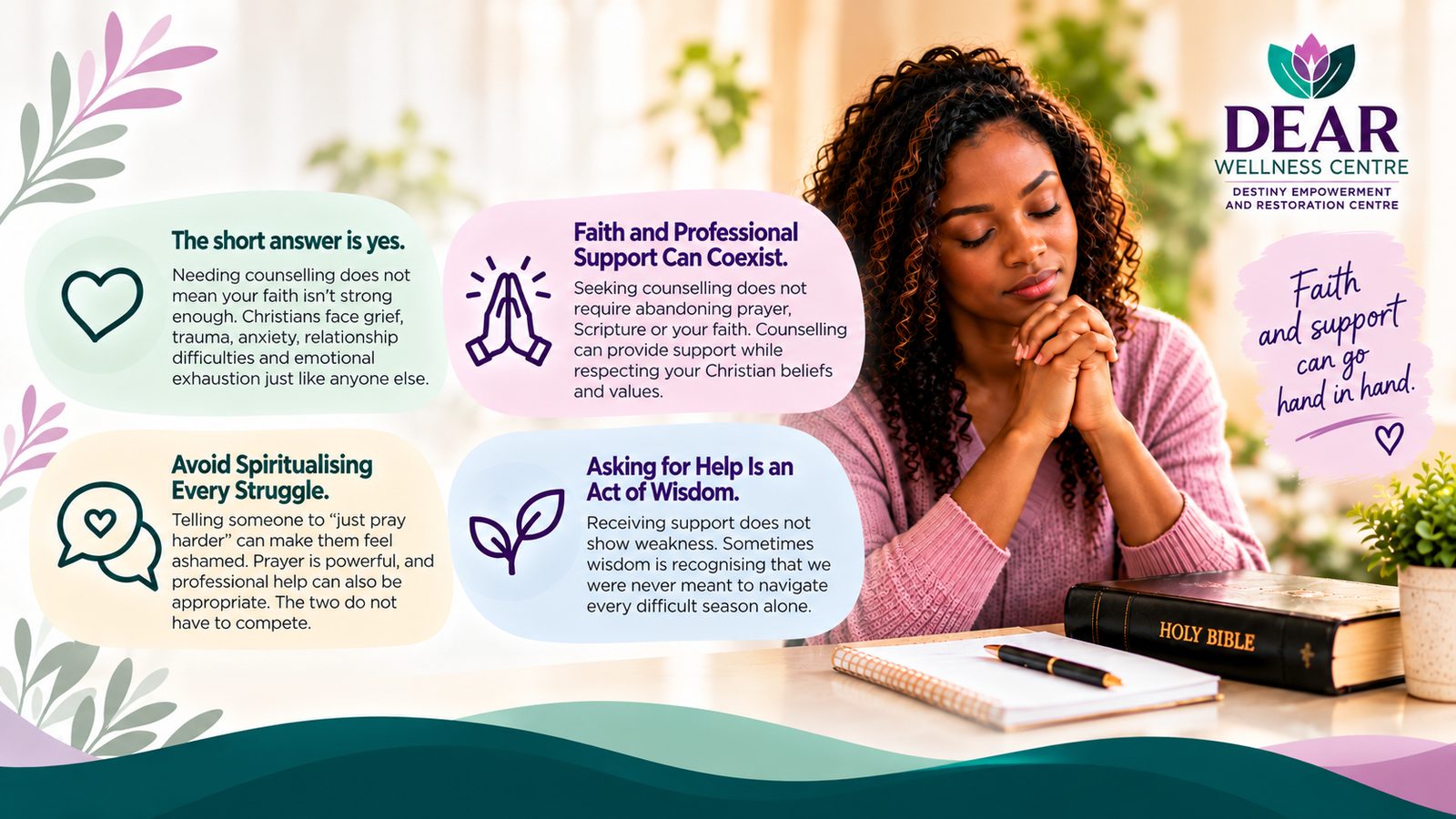
For some Christians, deciding to seek counselling can bring an unexpected question:
“Does needing counselling mean my faith isn’t strong enough?”
The short answer is no.
Christians experience grief, trauma, anxiety, relationship difficulties, family conflict, disappointment and emotional exhaustion just like anyone else. Faith can be a tremendous source of strength, but having faith does not make a person immune to emotional pain.
Seeking support does not mean that prayer has failed or that your relationship with God is weak.
Faith and Professional Support Can Coexist
Counselling and faith do not have to compete.
For clients who desire it, counselling can provide a safe space to explore emotional concerns while also respecting Christian beliefs, values and spiritual practices.
This may include conversations about:
- faith and identity;
- grief and loss;
- forgiveness;
- relationships;
- purpose;
- hope;
- spiritual struggles;
- boundaries; and
- coping during difficult seasons.
Prayer and Scripture are also incorporated when the client wants this and when it is appropriate to the counselling process.
The key is that faith integration should support the client, not pressure them.
Emotional Struggles Are Not Always Spiritual Failures
Sometimes people experiencing distress are told:
“You just need to pray more.”
“You need stronger faith or
“If you trusted God enough, you wouldn’t feel this way.”
Statements like these can unintentionally create shame.
They may cause someone to believe that anxiety, grief, depression, trauma or emotional exhaustion are signs of spiritual weakness.
But emotional pain is part of being human.
A person can love God deeply and still need support.
They can pray and still feel overwhelmed.
They can have faith and still struggle.
Avoid Spiritualising Every Struggle
Faith can be a meaningful part of healing, but not every emotional difficulty should automatically be reduced to a spiritual problem.
Someone who has experienced trauma may need help understanding triggers and learning emotional regulation.
A grieving person may need space to process loss.
A couple experiencing conflict may need support improving communication.
A teenager struggling emotionally may need professional assessment and guidance.
In these situations, telling someone simply to “pray harder” may not address the full complexity of what they are experiencing.
Professional support can work alongside spiritual support.
Counselling Can Help You Explore Difficult Questions
People sometimes avoid counselling because they fear they will be judged for their beliefs.
Christian counselling can provide a space where faith-related questions can be explored respectfully.
For example:
“Why did God allow this to happen?”
“Why am I still struggling even though I pray?”
“How do I forgive without allowing someone to keep hurting me?”
“How do I trust God after disappointment?”
These are deeply personal questions.
Counselling does not always provide simple answers, but it can create a safe place to explore what these experiences mean for you.
Asking for Help Can Be an Act of Wisdom
Receiving support from another person does not automatically mean weakness.
In many areas of life, we seek guidance when we need it.
We consult doctors about physical health.
We seek teachers when we want to learn.
We ask trusted people for advice when facing difficult decisions.
Emotional and psychological support can be approached in the same way.
Sometimes wisdom is recognising when a burden has become too heavy to carry alone.
Faith Can Be Part of the Healing Process
For some people, their relationship with God is central to how they make sense of suffering, hope and recovery.
Counselling can help clients draw upon faith as a source of strength while also developing practical skills for coping, communication, boundaries and emotional wellbeing.
This might include exploring:
- healthy versus unhealthy guilt;
- forgiveness without tolerating harm;
- boundaries in Christian relationships;
- grief and faith;
- identity and self-worth;
- purpose after loss;
- hope during uncertainty; and
- spiritual coping during difficult seasons.
Faith can support healing without replacing professional care when professional care is needed.
You Don’t Have to Choose
You do not necessarily have to choose between:
Prayer or counselling.
Faith or professional support.
Spiritual growth or emotional healing.
For many people, these can work together.
You can pray and talk.
You can trust God and ask for help.
You can have strong faith and still acknowledge that you are struggling.
🌸 DEAR Reflection
Have you been interpreting your need for support as a lack of faith?
Faith and professional support can go hand in hand. One step at a time is all it takes.
Leave Your Comment