
Connection before correction website

Connection Before Correction: A Different Approach to Discipline

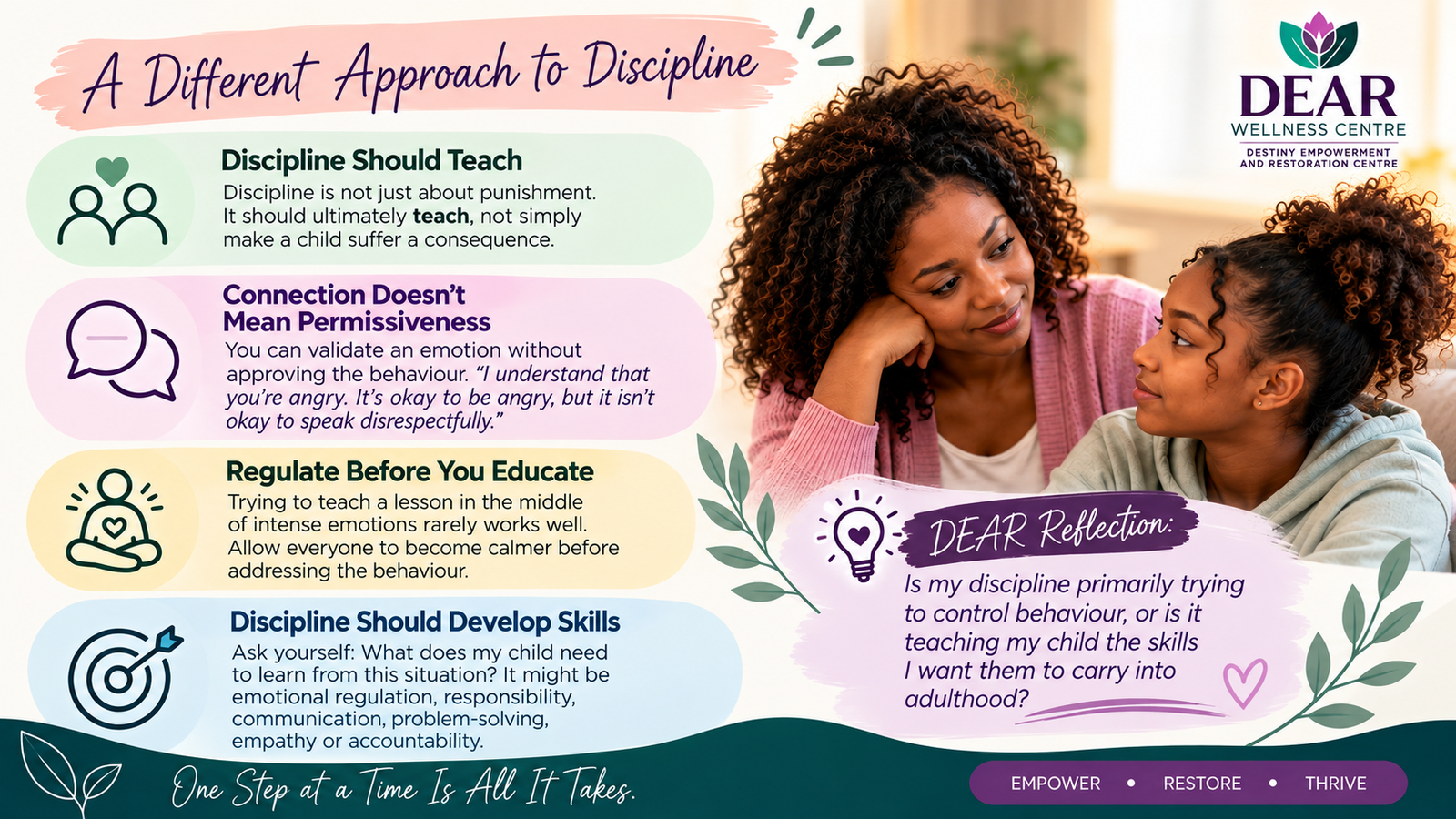
For many families, discipline has traditionally been associated with punishment.

A child breaks a rule, a consequence follows and the matter is considered resolved.

But effective discipline should do more than stop unwanted behaviour in the moment.

It should teach.

The goal of discipline is to help children gradually develop the skills they will need to manage themselves, their relationships and their responsibilities as they grow.

This is where the principle of connection before correction becomes valuable.


What Does Connection Before Correction Mean?

Connection before correction means recognising that children and adolescents are often more receptive to guidance when they feel emotionally safe and understood.

It does not mean allowing disrespectful or harmful behaviour.

It does not mean avoiding consequences.

And it certainly does not mean that parents have to agree with everything their child feels or does.

Connection simply helps create the emotional conditions in which correction is more likely to be effective.


Connection Doesn’t Mean Permissiveness

Parents can acknowledge a child’s feelings while still holding a clear boundary.

For example:

“I understand that you’re angry. It’s okay to be angry, but it isn’t okay to speak disrespectfully.”

Two things are happening at the same time.

The emotion is acknowledged.

The boundary remains.

Children need both.

When parents respond only to the behaviour, the child may hear:

“Your feelings don’t matter.”

When parents acknowledge only the emotion without maintaining boundaries, the child may not learn accountability.

Healthy discipline combines empathy with expectations.


Regulate Before You Educate

Trying to teach an important lesson while everyone is highly emotional rarely works well.

When a child is extremely angry, frightened or overwhelmed, their ability to listen, think through consequences and problem-solve may be reduced.

Parents can experience the same thing.

Sometimes the most productive response is to pause.

This may sound like:

“We’re both upset right now. We’re going to take some time to calm down, and then we’ll come back and talk about what happened.”

The issue is not being ignored.

It is simply being addressed at a time when learning is more likely to occur.


Ask What the Child Needs to Learn

Before deciding on a consequence, ask:

“What does my child need to learn from this situation?”

Perhaps the lesson is about:

  • emotional regulation;
  • responsibility;
  • honesty;
  • communication;
  • problem-solving;
  • empathy;
  • repairing harm;
  • respecting boundaries; or
  • accountability.

A consequence becomes more meaningful when it is connected to the behaviour and the skill that needs to develop.

For example, if a young person damages something during an argument, part of the response may involve repairing or replacing the item and discussing healthier ways to manage anger.

That teaches more than punishment alone.


Discipline Should Prepare Children for Adulthood

Parents are not simply managing today’s behaviour.

They are helping children develop skills they will eventually need without parental supervision.

A child who learns to regulate frustration, communicate respectfully, solve problems and accept responsibility is developing skills that can later support friendships, romantic relationships, education and employment.

That is the larger goal of discipline.


Connection Makes Correction Stronger

Children do not need perfect parents.

They need parents who can maintain boundaries while communicating:

“Your behaviour matters, and so do you.”

Connection does not remove authority.

Used appropriately, it can make parental guidance more effective.


🌸 DEAR Reflection

Is my discipline primarily trying to control behaviour, or is it teaching my child the skills I want them to carry into adulthood?


Supportive Mother and Withdrawn Son

Behind the Behaviour: Why Is My Teen So Angry?

Teen anger can be difficult for families.

It may appear as shouting, slamming doors, sarcasm, defiance, arguments or sudden emotional outbursts.

When anger becomes the most visible behaviour, it is easy to focus only on stopping it.

But anger is often a surface emotion.

Underneath it may be something more vulnerable.

Anger May Be Covering Something Else

A teenager who appears angry may actually be feeling:

  • hurt;
  • embarrassed;
  • rejected;
  • disappointed;
  • overwhelmed;
  • anxious;
  • afraid;
  • powerless; or
  • misunderstood.

For some teens, anger feels easier to express than sadness or fear.

Saying:

“Leave me alone!”

may feel safer than saying:

“I’m hurting.”

Why Anger Can Feel Protective

Anger can create distance.

It can help a young person feel stronger when they feel vulnerable.

It can also provide a temporary sense of control.

This does not mean the behaviour is acceptable.

Understanding the function of anger simply helps parents respond more effectively.

Understand Without Excusing

A trauma-informed approach does not mean removing consequences.

You can validate emotion while maintaining boundaries.

For example:

“I can see that you’re very upset. I want to understand what happened, but it is not okay to speak disrespectfully.”

This communicates two things:

Your feelings matter.

Your behaviour still has limits.

Both are important.

Look for Triggers

Try to notice patterns.

Does the anger happen:

  • after school;
  • after social media use;
  • around certain friendships;
  • when the teen feels criticised;
  • when they are tired;
  • during academic pressure;
  • when they feel controlled;
  • after conflict between adults;
  • around certain topics; or
  • when they feel embarrassed?

Patterns can provide valuable clues about what the anger is communicating.

Regulate Before You Reason

Trying to teach a lesson during an emotional explosion is usually ineffective.

When a teen is highly activated, they may not be able to process a long lecture or problem-solve well.

Parents can say:

“We’re going to pause this conversation and come back to it when we’re both calmer.”

That is not avoidance.

It is regulation.

The conversation still needs to happen later.

Help Your Teen Build Emotional Language

Some young people know only a few emotional labels:

angry.

fine.

sad.

Teach broader emotional vocabulary.

A teen who can say:

“I felt embarrassed.”

“I was anxious.”

“I felt rejected.”

is more likely to communicate than explode.

Emotional literacy reduces the need for behaviour to carry the entire message.

Model the Behaviour You Want

Parents are powerful models.

If adults respond to frustration through yelling, insults or intimidation, teenagers receive a mixed message when they are told to stay calm.

You do not have to be perfect.

But modelling:

  • pausing;
  • apologising;
  • using respectful language;
  • naming emotions; and
  • returning to difficult conversations calmly

teaches more than instructions alone.

When Anger Is More Than Typical

Seek additional support if anger becomes:

  • physically aggressive;
  • threatening;
  • destructive;
  • persistent;
  • increasingly intense;
  • linked to substance use;
  • associated with self-harm; or
  • severely disruptive to family or school functioning.

Anger can sometimes be connected to anxiety, depression, trauma, bullying, grief or other concerns that deserve closer attention.

Behind the Behaviour

The question is not only:

“How do I stop the anger?”

It is also:

“What is the anger trying to communicate?”

Understanding does not remove accountability.

It helps parents respond to both the behaviour and the need underneath it.

🌸 DEAR Reflection

What might my teen’s anger be protecting or communicating?

Understanding When Privacy May Be More Than Privacy

Behind the Behaviour: Why Is My Teen Always in Their Room?

A closed bedroom door can become a source of tension in many families.

Parents may worry that their teen is becoming antisocial, hiding something or disconnecting from the family.

Teenagers, on the other hand, may simply feel that their room is the one place where they have privacy and control.

The important question is not:

“Is my teen spending time alone?”

It is:

“What is happening alongside the isolation?”

Privacy Is Part of Adolescence

As teenagers grow, they naturally seek more independence.

Their room may become a place to:

  • decompress;
  • talk with friends;
  • listen to music;
  • study;
  • sleep;
  • think;
  • use social media; or
  • simply enjoy being alone.

Privacy itself is not unhealthy.

The concern is when isolation becomes persistent and is accompanied by significant changes in mood or functioning.

Ask What Has Changed

Consider:

Is this new?

Are they still spending time with friends?

Are they attending school?

Are they eating normally?

Are they participating in activities they enjoy?

Are they functioning differently from before?

A teen who enjoys several hours alone but still maintains relationships and responsibilities may simply need more private time.

A teen who has withdrawn from nearly everything may require closer attention.

Withdrawal Can Have Many Meanings

A teen may spend more time alone because they are:

  • tired;
  • overwhelmed;
  • introverted;
  • studying;
  • gaming;
  • socialising online;
  • avoiding family conflict;
  • being bullied;
  • anxious;
  • depressed;
  • grieving; or
  • trying to cope with something they do not know how to discuss.

This is why context matters.

Don’t Turn the Bedroom Into a Battleground

Constantly demanding that a teenager leave their room can create a power struggle.

Instead of focusing only on where they are physically located, focus on connection.

Try:

“I haven’t seen much of you today. Come sit with me for a few minutes when you’re ready.”

Or create routine family connection through:

  • shared meals;
  • weekly outings;
  • errands;
  • walks;
  • short check-ins;
  • television time; or
  • small household routines.

Connection can be brief and still meaningful.

Respect Privacy Without Disappearing

Giving teens privacy does not mean becoming uninvolved.

Parents still need to know:

  • who their teen is spending time with;
  • how they are functioning;
  • whether they are safe;
  • whether school attendance is stable;
  • whether there are major changes in behaviour; and
  • whether there are signs of emotional distress.

Healthy parenting during adolescence involves gradually increasing independence while maintaining appropriate supervision.

Watch for Warning Signs

Withdrawal deserves more attention if it is combined with:

  • persistent sadness;
  • hopelessness;
  • self-harm;
  • suicidal comments;
  • major sleep disruption;
  • school refusal;
  • sudden friendship loss;
  • significant weight or appetite changes;
  • substance use; or
  • loss of interest in almost everything.

These signs should not be dismissed simply as a teen wanting privacy.

Connection Does Not Always Require Conversation

Sometimes parents assume that quality time must involve a serious discussion.

It does not.

Sitting together quietly can matter.

Driving somewhere can matter.

Sharing food can matter.

Watching a show can matter.

Small moments of connection help maintain the relationship so that deeper conversations have somewhere to begin.

Behind the Behaviour

Instead of asking only:

“Why are you always in your room?”

consider:

“What is my teen getting from being alone right now?”

The answer may be independence.

It may be rest.

It may be avoidance.

It may be emotional protection.

Curiosity helps parents distinguish between normal privacy and meaningful withdrawal.

🌸 DEAR Reflection

Am I respecting my teen’s need for privacy while still staying emotionally connected and observant?

Academic stress

When Academic Pressure Becomes Too Much

Academic success can open doors.

It can build confidence, create opportunities and help young people develop discipline and perseverance.

But when achievement becomes closely tied to a young person’s identity, family approval or sense of worth, academic pressure can become emotionally overwhelming.

For some teenagers, school stress is no longer simply about completing assignments or preparing for exams.

It becomes:

“What if I fail?”

“What if I disappoint everyone?”

“What if I’m not good enough?”

That is when academic pressure may begin affecting mental and emotional wellbeing.

Pressure Can Come From Many Directions

Academic pressure is not always created by parents.

It can come from:

  • teachers;
  • peers;
  • competition;
  • social media;
  • fear about university or employment;
  • personal perfectionism;
  • comparison with siblings; or
  • the student’s own expectations.

Sometimes parents believe they are simply encouraging their child, while the teen may experience the same message as intense pressure.

Look Beyond the Grades

A teenager can still be achieving highly while struggling emotionally.

Good grades do not automatically mean everything is fine.

Watch for signs such as:

  • constant worry about results;
  • crying over mistakes;
  • difficulty sleeping;
  • headaches or stomach complaints;
  • panic before tests;
  • procrastination because of fear of failure;
  • extreme perfectionism;
  • irritability;
  • reduced appetite;
  • avoidance of school;
  • loss of enjoyment;
  • saying things like “I’m stupid” or “I’m a failure”; or
  • believing they have disappointed the family.

The issue is not simply the amount of schoolwork.

It is how the teen is experiencing and interpreting the pressure.

Avoid Making Achievement Their Identity

Children and teens often absorb the messages adults repeatedly communicate.

Statements such as:

“You’re the smart one.”

“You always get top marks.”

“You have to do better than that.”

may unintentionally teach a child that their value is connected to performance.

When achievement becomes identity, mistakes can feel threatening.

A poor grade may not feel like:

“I did badly on this test.”

It may feel like:

“I am a failure.”

Parents can help by praising more than results.

Notice:

  • effort;
  • persistence;
  • improvement;
  • responsibility;
  • problem-solving;
  • courage;
  • curiosity; and
  • resilience.

Ask About the Experience, Not Only the Outcome

Instead of asking only:

“What grade did you get?”

also ask:

“How did you feel about the test?”

“What was the hardest part?”

“What did you learn?”

“What support would help?”

These questions communicate that the child matters beyond the result.

Help Your Teen Build Balance

Healthy academic functioning includes rest.

Teenagers need sleep, recreation, relationships and time away from performance-based activities.

Parents can help their teen develop:

  • realistic study schedules;
  • regular breaks;
  • healthy sleep routines;
  • time for physical activity;
  • boundaries around late-night studying;
  • balanced expectations; and
  • permission to recover after demanding periods.

Rest is not laziness.

It supports concentration, memory, emotional regulation and learning.

Teach Them How to Respond to Failure

Failure is uncomfortable.

But learning how to respond to setbacks is an important developmental skill.

Instead of immediately rescuing, criticising or catastrophising, help your teen reflect.

Ask:

“What happened?”

“What can you learn from this?”

“What would you do differently next time?”

“What support do you need?”

This helps transform failure from a threat into feedback.

Be Careful With Comparison

Comparing teenagers with siblings, classmates or cousins may be intended as motivation.

But it can easily create shame.

Statements such as:

“Your brother never had this problem.”

or

“Look how well your friend is doing.”

may communicate:

“You are not enough.”

Each young person develops differently.

Comparison often increases pressure without improving performance.

When Academic Stress Needs More Attention

Professional support may be appropriate if academic pressure is contributing to:

  • severe anxiety;
  • frequent panic;
  • persistent sleep problems;
  • self-harm;
  • hopelessness;
  • significant school avoidance;
  • eating difficulties;
  • emotional breakdowns; or
  • statements suggesting suicidal thinking.

At that stage, the priority is not simply performance.

It is wellbeing and safety.

Success Should Not Cost a Teen Their Wellbeing

Young people need encouragement.

They also need to know that they are valued when they succeed and when they struggle.

The goal is not to remove every challenge.

It is to help them face challenge without believing that their worth depends on the outcome.

🌸 DEAR Reflection

Am I helping my teen pursue excellence, or unintentionally teaching them that they are only valuable when they achieve?

Angry teen

When Your Teen Stops Talking to You

It can be unsettling when a teenager who once talked openly with you suddenly becomes quiet, distant or difficult to reach.

As children move into adolescence, some increase in privacy and independence is normal. Teenagers begin forming stronger peer relationships, developing their own opinions and creating a sense of identity that is separate from their parents.

But when communication changes significantly, parents may start to wonder whether something deeper is happening.

The challenge is knowing when to give space, when to lean in and when to seek additional support.

Silence Does Not Always Mean Rejection

When a teen stops talking, parents may naturally interpret it as disrespect, secrecy or rejection.

Sometimes that may be part of what is happening.

But silence can also mean:

  • “I don’t know how to explain what I’m feeling.”
  • “I’m afraid you’ll be disappointed.”
  • “I think you’ll get angry.”
  • “I’m embarrassed.”
  • “I don’t want to make things worse.”
  • “I don’t even understand what’s going on myself.”

A teenager may withdraw not because they do not care about the relationship, but because they are unsure whether the conversation will feel emotionally safe.

Don’t Force the Conversation

When parents are worried, they often ask repeated questions.

“What’s wrong?”

“Why won’t you talk to me?”

“Tell me what happened.”

Although these questions usually come from concern, a teen may experience them as pressure.

Sometimes a better approach is to communicate availability without demanding immediate disclosure.

You might say:

“You don’t have to talk right now, but I want you to know I’m here when you’re ready.”

Or:

“I’ve noticed you’ve been quieter lately. I’m not trying to pressure you. I just want you to know I care.”

This allows the young person to retain some control over when and how they talk.

Pay Attention to the Pattern

One quiet day is not necessarily a cause for concern.

Look at the wider picture.

Has your teen also:

  • stopped spending time with friends;
  • lost interest in activities they usually enjoy;
  • begun missing school;
  • experienced a drop in academic performance;
  • changed their sleeping or eating habits;
  • become unusually irritable;
  • withdrawn from family activities;
  • become secretive in ways that feel significantly different; or
  • expressed hopelessness?

A combination of changes lasting over time may suggest that your teen is struggling.

Create Low-Pressure Opportunities for Connection

Not every meaningful conversation needs to happen face-to-face at a table.

Teenagers sometimes talk more easily when attention is not focused directly on them.

Try connecting while:

  • driving;
  • cooking;
  • walking;
  • watching television;
  • doing errands;
  • having a snack; or
  • sitting together quietly.

Sometimes connection develops before conversation.

A teen may begin by talking about something small before they feel ready to talk about what is really bothering them.

Listen Before You Fix

Parents often want to solve the problem quickly.

But a teenager may first need to feel heard.

When your teen starts talking, try to avoid immediately:

  • interrupting;
  • correcting;
  • giving advice;
  • minimising;
  • comparing;
  • lecturing; or
  • telling them what they should have done.

Instead, respond with curiosity.

You might say:

“That sounds really difficult.”

“I can understand why you felt upset.”

“Thank you for telling me.”

“What do you need from me right now?”

Sometimes the most important thing a parent can provide is a calm, non-judgmental presence.

Be Aware of Your Reactions

Teenagers pay close attention to how adults respond.

If every disclosure leads to anger, panic, criticism or punishment, they may become less likely to share.

This does not mean parents should ignore serious behaviour.

It means that the first response matters.

You can still set boundaries, address inappropriate behaviour and make necessary decisions.

But if your teen has shared something difficult, first communicate:

“I’m glad you told me.”

That one sentence can help protect the relationship.

When Professional Support May Help

Sometimes a young person finds it easier to talk with someone outside the family.

Professional support may be helpful if your teen is experiencing:

  • prolonged withdrawal;
  • anxiety;
  • persistent sadness;
  • self-harm;
  • suicidal thoughts;
  • bullying;
  • major family stress;
  • trauma;
  • substance use;
  • school refusal; or
  • significant changes in functioning.

Seeking support does not mean the parent-child relationship has failed.

Sometimes a teen needs another safe space while the family continues providing connection and stability at home.

Keep the Door Open

Parents do not need to force every conversation.

Your role is to make sure the door remains open.

Continue showing interest.

Continue noticing.

Continue creating opportunities for connection.

And continue communicating that your teen can come to you, even when the conversation is difficult.

🌸 DEAR Reflection

When my teen talks to me, do they experience me as someone who listens first, or someone who immediately reacts?

Workplace Wellness and Burnout Awareness

Burnout Isn’t Just Being Tired

Everyone gets tired.

After a demanding week, a busy period or several nights of poor sleep, most people will feel physically and mentally drained.

Rest may help.

Burnout is different.

Burnout can develop following prolonged workplace stress and may involve emotional exhaustion, increasing distance or negativity toward work and a reduced sense of professional effectiveness.

It is more than simply needing a weekend off.

Burnout Can Develop Gradually

Burnout does not always begin with a dramatic breakdown.

It may develop slowly.

At first, you may notice that you are more tired than usual.

Then you begin feeling irritable.

Motivation decreases.

Tasks that once felt manageable start feeling difficult.

You may dread going to work or find yourself emotionally distancing from colleagues, clients or the purpose that originally attracted you to your profession.

Because these changes develop gradually, people sometimes normalise them.

They tell themselves:

“I’m just tired.”

“Things will settle down soon.”

“I just need to push through.”

Sometimes they do.

Sometimes the stress remains.

Rest Alone May Not Solve Burnout

A weekend away, vacation or self-care activity may provide temporary relief.

But if the conditions producing chronic stress remain unchanged, exhaustion often returns.

This is why burnout cannot always be addressed by telling an exhausted employee to “rest more.”

The wider environment may also need attention.

Factors may include:

  • excessive workload;
  • unclear expectations;
  • insufficient resources;
  • difficult workplace relationships;
  • poor boundaries;
  • lack of recognition;
  • limited autonomy;
  • inadequate staffing;
  • inconsistent leadership; or
  • low psychological safety.

Individual coping strategies matter, but they cannot compensate indefinitely for unhealthy systems.

Pay Attention to Early Signs

Possible signs of burnout may include:

  • emotional exhaustion;
  • irritability;
  • reduced motivation;
  • difficulty concentrating;
  • increased cynicism;
  • dread about going to work;
  • reduced sense of accomplishment;
  • feeling detached from colleagues or clients;
  • difficulty switching off after work; and
  • feeling disconnected from the purpose of your role.

Recognising these signs early creates an opportunity to respond before exhaustion becomes more severe.

What Can Individuals Do?

Personal strategies can still be helpful.

Consider whether you need to:

  • reassess your boundaries;
  • take available leave;
  • seek supervision or support;
  • discuss workload concerns;
  • reduce unnecessary commitments;
  • improve recovery time outside work;
  • reconnect with supportive relationships; or
  • seek professional help if stress is significantly affecting your wellbeing.

The goal is not to become better at tolerating unhealthy conditions.

The goal is to identify what can realistically change.

Organisations Have a Role Too

Workplace wellness cannot consist solely of encouraging employees to meditate, exercise or practise self-care.

Those things can be helpful.

But healthy organisations also examine their systems.

Leadership should consider:

Are workloads reasonable?

Are expectations clear?

Do employees feel safe raising concerns?

Are staff adequately supported?

Is communication effective?

Are people recognised for their contributions?

Are boundaries between work and personal life respected?

Are employees continually being asked to do more with fewer resources?

These questions move workplace wellness beyond individual responsibility.

Wellness Is a Shared Responsibility

Employees have a role in protecting their wellbeing.

Organisations also have a responsibility to create environments in which people can reasonably function without chronic, unmanaged stress.

The strongest workplace wellness strategies address both.

🌸 DEAR Reflection

Is your workplace addressing burnout—or simply asking exhausted employees to become better at tolerating it?

Sunset Reflections and New Beginnings

Feeling Stuck? It May Be Time for Your Next Chapter

Sometimes nothing is dramatically wrong.

Your life may appear relatively stable.

You may still be working, caring for your responsibilities and moving through your usual routines.

Yet something inside you keeps saying:

“I can’t stay here forever.”

You may have outgrown a career direction, routine, relationship pattern, personal goal or even an older version of yourself.

But knowing that something needs to change does not always mean knowing what should come next.

That uncertainty can feel like being stuck.

Sometimes, however, feeling stuck is actually a sign that you are in transition.

You May Have Outgrown Something

Growth sometimes creates discomfort before it creates clarity.

The things that once motivated you may no longer feel meaningful.

Goals you once worked toward may no longer fit the person you are becoming.

A routine that once felt comfortable may begin to feel limiting.

This does not necessarily mean you made the wrong choices previously.

It may simply mean that your needs, priorities or values have changed.

Start With Clarity

When we feel uncertain, we often jump immediately to:

“What should I do next?”

Before trying to make a major decision, begin by understanding where you are now.

Ask yourself:

What matters to me now?

What do I want more of in my life?

What am I ready to leave behind?

What feels draining?

What gives me energy?

What would meaningful progress look like over the next six months?

These questions may reveal that what you need is not necessarily a dramatic life change.

Sometimes you need a new boundary, a different routine, a conversation, a new skill or permission to pursue something that matters to you.

Don’t Wait for Perfect Certainty

Many people postpone change because they want to feel completely certain before taking the first step.

But clarity often develops through action.

You learn by doing.

You take one manageable step.

You observe what happens.

You adjust.

Then you take another step.

This approach reduces the pressure to have everything figured out in advance.

Small Steps Can Create Momentum

If you want to change careers, the first step may not be resigning from your job.

It may be researching an area that interests you.

If you want to improve your wellbeing, the first step may not be transforming your entire lifestyle.

It might be protecting one evening each week for rest.

If you want better relationships, the first step may be one honest conversation.

Small steps matter because they create information, experience and momentum.

Your Next Chapter Doesn’t Require Rejecting the Previous One

Moving forward does not mean that everything about your past was wrong.

A previous season may have served an important purpose.

You can appreciate what it gave you while still recognising that you are ready for something different.

Growth allows us to honour where we have been while making space for where we are going.

One Step at a Time

You do not need a five-year plan before beginning.

Sometimes the next right step is enough.

Take it.

Learn from it.

Then decide what comes next.

🌸 DEAR Reflection

What is one small decision you could make this week that moves you closer to the life you want?

Christian prayer

Can Christians Go to Counselling?

For some Christians, deciding to seek counselling can bring an unexpected question:

“Does needing counselling mean my faith isn’t strong enough?”

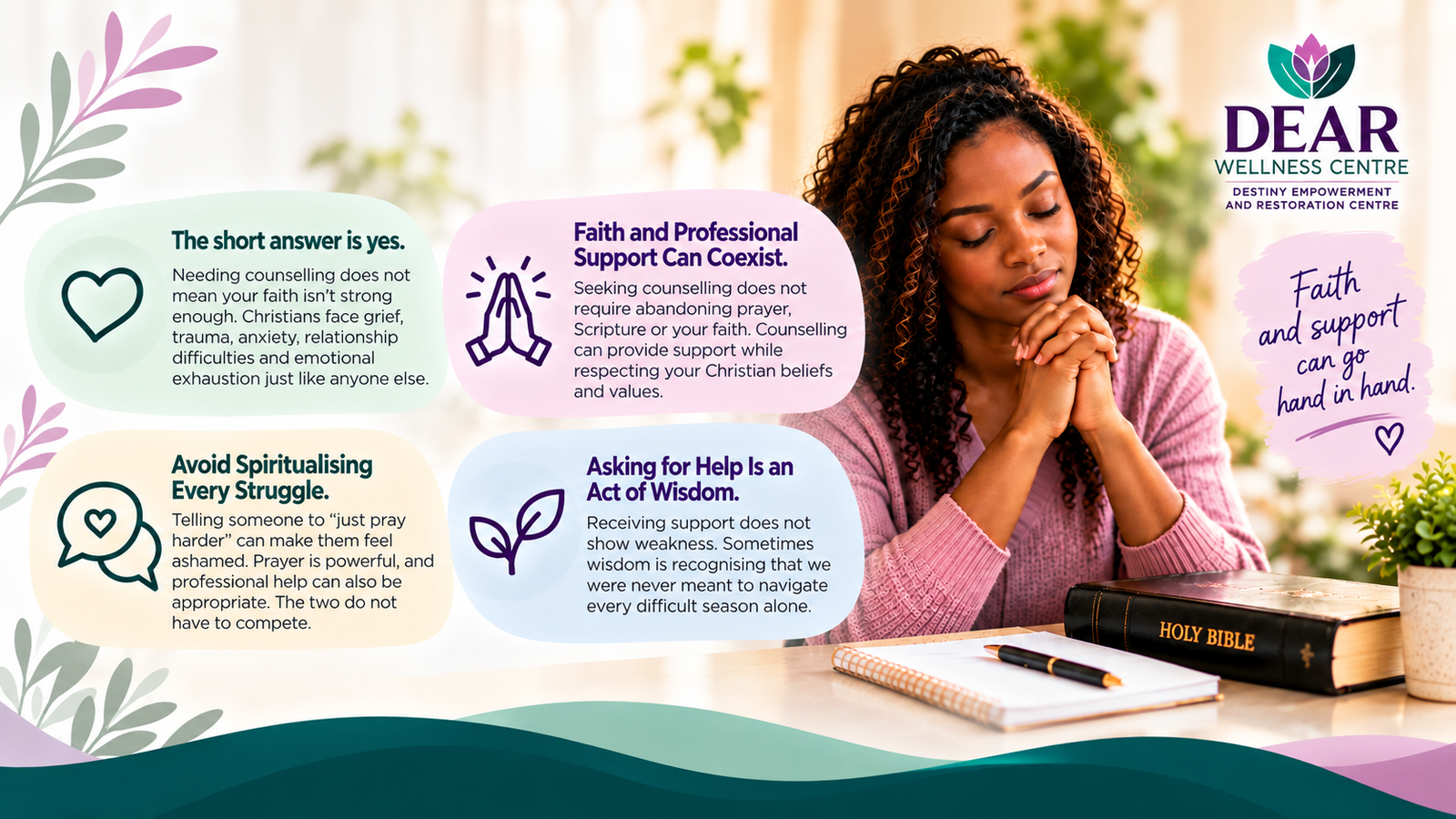
The short answer is no.

Christians experience grief, trauma, anxiety, relationship difficulties, family conflict, disappointment and emotional exhaustion just like anyone else. Faith can be a tremendous source of strength, but having faith does not make a person immune to emotional pain.

Seeking support does not mean that prayer has failed or that your relationship with God is weak.

Faith and Professional Support Can Coexist

Counselling and faith do not have to compete.

For clients who desire it, counselling can provide a safe space to explore emotional concerns while also respecting Christian beliefs, values and spiritual practices.

This may include conversations about:

  • faith and identity;
  • grief and loss;
  • forgiveness;
  • relationships;
  • purpose;
  • hope;
  • spiritual struggles;
  • boundaries; and
  • coping during difficult seasons.

Prayer and Scripture are also incorporated when the client wants this and when it is appropriate to the counselling process.

The key is that faith integration should support the client, not pressure them.

Emotional Struggles Are Not Always Spiritual Failures

Sometimes people experiencing distress are told:

“You just need to pray more.”

“You need stronger faith or

“If you trusted God enough, you wouldn’t feel this way.”

Statements like these can unintentionally create shame.

They may cause someone to believe that anxiety, grief, depression, trauma or emotional exhaustion are signs of spiritual weakness.

But emotional pain is part of being human.

A person can love God deeply and still need support.

They can pray and still feel overwhelmed.

They can have faith and still struggle.

Avoid Spiritualising Every Struggle

Faith can be a meaningful part of healing, but not every emotional difficulty should automatically be reduced to a spiritual problem.

Someone who has experienced trauma may need help understanding triggers and learning emotional regulation.

A grieving person may need space to process loss.

A couple experiencing conflict may need support improving communication.

A teenager struggling emotionally may need professional assessment and guidance.

In these situations, telling someone simply to “pray harder” may not address the full complexity of what they are experiencing.

Professional support can work alongside spiritual support.

Counselling Can Help You Explore Difficult Questions

People sometimes avoid counselling because they fear they will be judged for their beliefs.

Christian counselling can provide a space where faith-related questions can be explored respectfully.

For example:

“Why did God allow this to happen?”

“Why am I still struggling even though I pray?”

“How do I forgive without allowing someone to keep hurting me?”

“How do I trust God after disappointment?”

These are deeply personal questions.

Counselling does not always provide simple answers, but it can create a safe place to explore what these experiences mean for you.

Asking for Help Can Be an Act of Wisdom

Receiving support from another person does not automatically mean weakness.

In many areas of life, we seek guidance when we need it.

We consult doctors about physical health.

We seek teachers when we want to learn.

We ask trusted people for advice when facing difficult decisions.

Emotional and psychological support can be approached in the same way.

Sometimes wisdom is recognising when a burden has become too heavy to carry alone.

Faith Can Be Part of the Healing Process

For some people, their relationship with God is central to how they make sense of suffering, hope and recovery.

Counselling can help clients draw upon faith as a source of strength while also developing practical skills for coping, communication, boundaries and emotional wellbeing.

This might include exploring:

  • healthy versus unhealthy guilt;
  • forgiveness without tolerating harm;
  • boundaries in Christian relationships;
  • grief and faith;
  • identity and self-worth;
  • purpose after loss;
  • hope during uncertainty; and
  • spiritual coping during difficult seasons.

Faith can support healing without replacing professional care when professional care is needed.

You Don’t Have to Choose

You do not necessarily have to choose between:

Prayer or counselling.

Faith or professional support.

Spiritual growth or emotional healing.

For many people, these can work together.

You can pray and talk.

You can trust God and ask for help.

You can have strong faith and still acknowledge that you are struggling.

🌸 DEAR Reflection

Have you been interpreting your need for support as a lack of faith?

Faith and professional support can go hand in hand. One step at a time is all it takes.

Trauma-Informed Wellness Reflection Banner (1)

Trauma Doesn’t Always Look Like Trauma

When people hear the word trauma, they often imagine one catastrophic event.

And certainly, deeply distressing events can have a significant psychological and emotional impact.

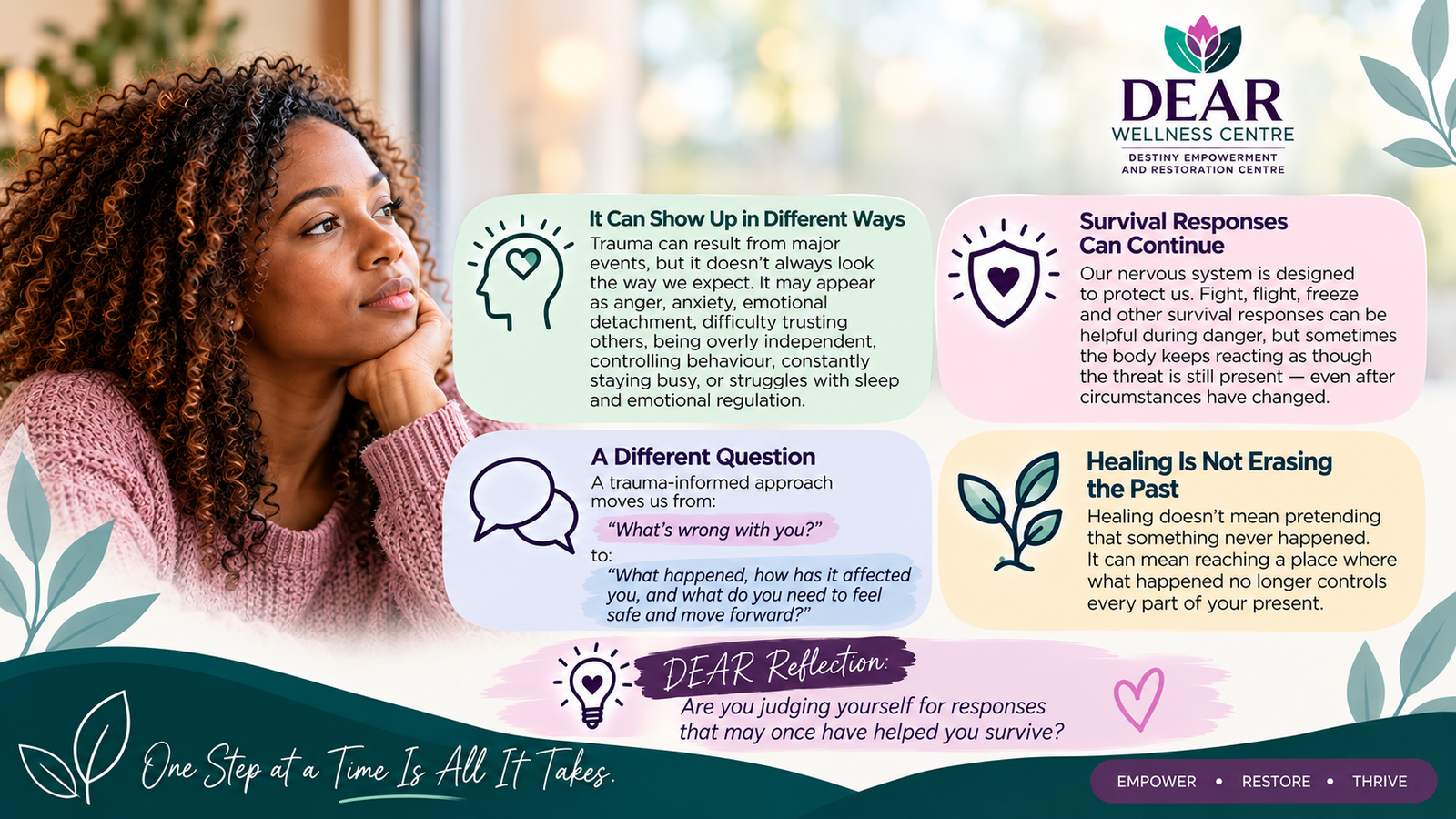
But trauma and its effects do not always look the way we expect.

Sometimes a person who has been deeply affected by difficult experiences does not appear visibly distressed at all.

They may appear highly independent, constantly busy, emotionally detached, angry, anxious or unusually controlling.

Others may struggle with trust, sleep, relationships or emotional regulation without immediately recognising the connection between their current reactions and earlier experiences.

Trauma Can Affect How We Experience the Present

The human nervous system is designed to help protect us from danger.

During threatening situations, the body may activate survival responses such as fight, flight or freeze.

These responses are useful when danger is present.

The difficulty can arise when the mind and body continue responding as though danger is still present even after circumstances have changed.

An ordinary disagreement may feel threatening.

A delayed message may trigger fear of rejection.

A raised voice may create an intense physical reaction.

A person may become extremely uncomfortable when they feel they have lost control.

From the outside, these reactions may appear excessive.

From inside the person’s experience, however, the nervous system may be trying to protect them.

Survival Responses Can Become Patterns

Some behaviours that appear unhealthy in adulthood may once have served an important protective function.

For example:

A person who rarely asks for help may have learned that relying on others was unsafe.

Someone who constantly monitors other people’s moods may have learned to anticipate conflict.

Someone who keeps constantly busy may find that slowing down allows painful memories or emotions to surface.

Understanding the origin of a behaviour does not mean that the behaviour must continue forever.

It provides context.

And context can help create a more compassionate starting point for change.

Trauma-Informed Support Asks a Different Question

When we see behaviour we do not understand, it is easy to ask:

“What’s wrong with you?”

A trauma-informed approach invites different questions:

“What happened?”

“How has it affected you?”

“What helps you feel safe?”

“What do you need in order to move forward?”

This shift does not remove personal responsibility.

It simply recognises that behaviour develops within a person’s experiences, relationships and environment.

Understanding those influences can help people develop healthier responses.

Healing Is Not Erasing the Past

Healing does not mean pretending something never happened.

It also does not require forgetting.

Healing may mean that the experience becomes one part of your story rather than controlling every part of your present.

It may look like:

  • recognising triggers;
  • learning emotional regulation;
  • developing healthier boundaries;
  • building safe relationships;
  • challenging beliefs formed during painful experiences;
  • asking for help;
  • learning to trust gradually; and
  • responding to the present rather than constantly reacting to the past.

Healing can take time.

Progress is rarely perfectly linear.

Your Responses May Have Had a Purpose

Sometimes people judge themselves harshly for the ways they cope.

They wonder why they cannot “just get over it.”

A more compassionate question may be:

“What was this response trying to protect me from?”

From there, you can begin asking whether the same response is still serving you today.

🌸 DEAR Reflection

Are you judging yourself for responses that may once have helped you survive?

Pastel Parenting Discipline Wellness Infographic

Connection Before Correction: A Different Approach to Discipline

For many families, discipline has traditionally been associated with punishment.

A child breaks a rule, a consequence follows and the matter is considered resolved.

But effective discipline should do more than stop unwanted behaviour in the moment.

It should teach.

The goal of discipline is to help children gradually develop the skills they will need to manage themselves, their relationships and their responsibilities as they grow.

This is where the principle of connection before correction becomes valuable.

What Does Connection Before Correction Mean?

Connection before correction means recognising that children and adolescents are often more receptive to guidance when they feel emotionally safe and understood.

It does not mean allowing disrespectful or harmful behaviour.

It does not mean avoiding consequences.

And it certainly does not mean that parents have to agree with everything their child feels or does.

Connection simply helps create the emotional conditions in which correction is more likely to be effective.

Connection Doesn’t Mean Permissiveness

Parents can acknowledge a child’s feelings while still holding a clear boundary.

For example:

“I understand that you’re angry. It’s okay to be angry, but it isn’t okay to speak disrespectfully.”

Two things are happening at the same time.

The emotion is acknowledged.

The boundary remains.

Children need both.

When parents respond only to the behaviour, the child may hear:

“Your feelings don’t matter.”

When parents acknowledge only the emotion without maintaining boundaries, the child may not learn accountability.

Healthy discipline combines empathy with expectations.

Regulate Before You Educate

Trying to teach an important lesson while everyone is highly emotional rarely works well.

When a child is extremely angry, frightened or overwhelmed, their ability to listen, think through consequences and problem-solve may be reduced.

Parents can experience the same thing.

Sometimes the most productive response is to pause.

This may sound like:

“We’re both upset right now. We’re going to take some time to calm down, and then we’ll come back and talk about what happened.”

The issue is not being ignored.

It is simply being addressed at a time when learning is more likely to occur.

Ask What the Child Needs to Learn

Before deciding on a consequence, ask:

“What does my child need to learn from this situation?”

Perhaps the lesson is about:

  • emotional regulation;
  • responsibility;
  • honesty;
  • communication;
  • problem-solving;
  • empathy;
  • repairing harm;
  • respecting boundaries; or
  • accountability.

A consequence becomes more meaningful when it is connected to the behaviour and the skill that needs to develop.

For example, if a young person damages something during an argument, part of the response may involve repairing or replacing the item and discussing healthier ways to manage anger.

That teaches more than punishment alone.

Discipline Should Prepare Children for Adulthood

Parents are not simply managing today’s behaviour.

They are helping children develop skills they will eventually need without parental supervision.

A child who learns to regulate frustration, communicate respectfully, solve problems and accept responsibility is developing skills that can later support friendships, romantic relationships, education and employment.

That is the larger goal of discipline.

Connection Makes Correction Stronger

Children do not need perfect parents.

They need parents who can maintain boundaries while communicating:

“Your behaviour matters, and so do you.”

Connection does not remove authority.

Used appropriately, it can make parental guidance more effective.

🌸 DEAR Reflection

Is my discipline primarily trying to control behaviour, or is it teaching my child the skills I want them to carry into adulthood?